Ann Bland, who married Robert Elliot and moved to Canada with her family, including her son and our ancestor William Elliot, was the daughter of Stephen Bland: he is named in several places, including the birth record of their son Josiah Elliot; also, his will names Ann the wife of Robert Elliot as his daughter. But who was Ann's mother? That's harder to figure out, as Stephen's will does not name a wife. I have a candidate for the position, but I don't have definite proof.
I believe that Ann Bland's mother may have been Eleanor Bland (birth name unknown). Here's my evidence: there is an Eleanor Bland who was buried at St. Paul's Church, Hammersmith, on August 16, 1810. This was the church which Robert and Ann attended. Just a few weeks later, on August 21, 1810, Stephen Bland of Hammersmith writes a will in which he leaves his estate to Ann and Robert (he also mentions their children John and Robert Jr.), his other daughter Harriott (sic) Pontifex, wife of Daniel Pontifex, and his son John Thomas Bland "son of my first wife Elizabeth Bland" (the implication being that Ann and Harriot are children from a second wife). He also leaves property to two other sons, Edward and James Bland. A few months later, on October 7, 1810, Stephen Bland dies and is also buried at St. Paul's Church in Hammersmith. I wish I could see their gravestones; they would probably definitively answer the question of their relationship! The book The History and Antiquities of the Parish of Hammersmith by Thomas Faulkner (London, 1839) lists the following Blands buried in the St. Paul's yard: E. Bland, 1741, E. Bland, 1764, John Bland, 1791, Stephen Bland, 1810, and James Bland, 1832. No female members of the Bland family are mentioned.
According to the website British History Online, the churchyard also contains a tombstone for "John Highlord Bland, late of St. James's Street, sword cutler and belt maker to the King, Prince of Wales, ye army, etc. 3 August 1791. Aged 59".
Suggestively, Robert and Ann name one of their daughters Eleanor. Eleanor Elliot was born in 1804, and died in 1809 at the age of five.
None of this consitutes definite proof, however. I have yet to find a marriage record for Stephen and Eleanor, or birth records for their children. I will keep looking.
UPDATE: Another researcher kindly sent me some marriage records for Stephen Bland. On August 3, 1755, Stephen Bland married Elizabeth Parker in Fulham, Middlesex, England. Elizabeth must have died since on May 18, 1769, Stephen married a second wife,Elianor Whittfield, again in Fulham. These records come from the West Middlesex Marriage Index, provided by the West Middlesex Family History Society. So it looks like Ann Bland's mother was Elianor or Eleanor Whittfield.
This brief obituary was found in the European Magazine and London Review, Volume 9, Spring 1786, under the article title "Monthly Obituary, April 1786". This must be for the second Mrs. Bland, Eleanor Whittfield.
Search This Blog
Showing posts with label Hammersmith. Show all posts
Thursday, August 7, 2014
Wednesday, January 16, 2013
From England to Ontario: Robert and Ann Elliot
In a previous post I wrote about William Elliot of Toronto and his amazing career. Right now I'm in the process of trying to discover more about William's parents, his siblings and his early environment. So far my research has provided me with an intriguing mix of definite information and information that's probably about the family but isn't specific enough to know for sure.
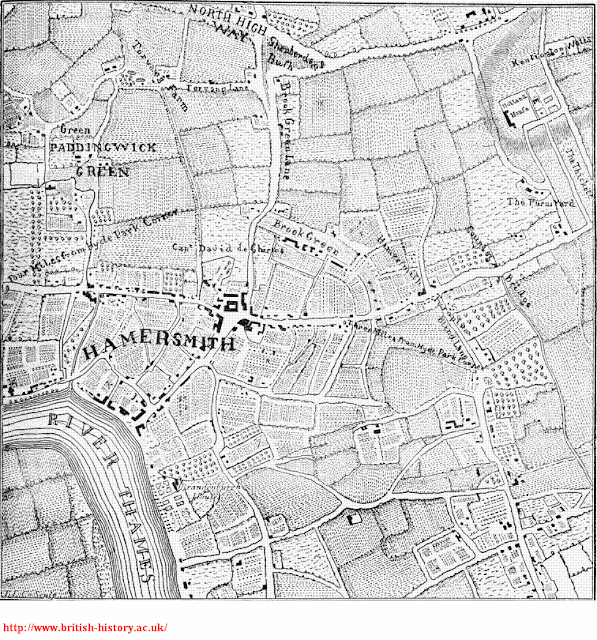
One of the cool things about William is that he's one of our only Canadian ancestors to have been born in England. Hammersmith, to be exact, which is now part of London but at the time of his birth was referred to as a "Hamlet". William's entry in the Dictionary of Canadian Biography provides the exact date (December 22, 1812) and place of his birth. Armed with this information, it was pretty easy to find his baptismal record.
This document gives us the name of both of William's parents (Robert and Ann), which is great. (It also explains why William gave his oldest son the name Robert). It doesn't give us Ann's maiden name, which is slightly less great, since Robert, Ann, and Elliot are all pretty common names. However, it does give us Robert Elliot's occupation, which is "currier" (a currier was a leather-worker).
The Dictionary of Canadian Biography has this to say about William's early life:
"William Elliot was educated at a boarding-school in London. His family immigrated to Dundas, Upper Canada, and he followed when he had completed his schooling at the age of 15. In 1834 he took up land near the town and started farming..."
And his obituary in the Globe (Tuesday, June 6, 1893) confirms that he was born in Hammersmith in December 1812 and also mentions that "Mr. John Elliot, for over 30 years clerk of the county court, was his eldest brother.".
So, these reliable sources of information tell us that William was the son of Robert and Ann Elliot, he had an older brother named John, his father was a currier, which put him in the tradesman class, they lived in Harrowsmith and they came to Canada before 1832. We also know that William went to boarding school, which indicates that the family had some money.
The Bishop's transcripts from the St. Paul, Hammersmith church show that William had at least three sisters, two of whom died young (one died before William was even born). Robert and Ann Elliot were the parents of Eleanor Elliot, born August 29, 1804, who died at age 5 in May, 1809; Mary Elliot, who was born on April 8, 1806; and Sarah Elliot, born October 10, 1809 and died at age 7 in May of 1817, when William would have been five years old. I haven't yet found a birth or baptismal record for John, William's older brother.
Here's where things get more conjectural. There are more records for a Robert Elliot in Middlesex, but I'm not sure if any of these are the right Robert Elliot. Here's what else I have:
These two records are from a database of land tax records in the greater London area. The first image is from 1825, and it shows that Robert Elliot is a tenant of a Mssr. Salter in Hammersmith (the place is named on an earlier page). His rent is 30 pounds (a year, I would imagine) and the tax on the property is 1 pound.
The second record is again for Hammersmith, in the year 1819. Robert Elliot has the same landlord. We don't know the rent, but the tax is 1 pound 5 shillings. Mr. Salter appears to own several properties in this area. At the very top of the page in red, it says "Angel Row".
Unfortunately these records don't list an occupation or names of other family members, so although the name and place matches up it's hard to make a definite identification.
This next record is from a database of duties paid for apprentice's indentures in the UK. In May 1798, a Robert Elliot, Currier, who lived in St. Martin's in the Fields, is recorded as having an apprentice named George Priestly. St. Martin's in the Fields is in Middlesex, and, like Hammersmith, is now part of London. This record has the right name and occupation but a different location. It's earlier than our previous records, so it's possible that Robert and his family moved to Hammersmith some time after May 1798. However, it's also possible that it's a different Robert Elliot.
Now we come to my all-time favourite document for the Elliot family. I really hope this is the right Robert Elliot--this paper is so beautiful and historic! You can even see the original seals. It comes from a database called "London, England, Freedom of the City Admission Papers" and is dated 1785. It's an apprenticeship indenture contract between Robert Elliot, "son of Charles Elliot of Hayes in the County of Middlesex, Victualler" and Thomas Burton of Newport Street, Currier of London. The apprenticeship is for seven years (which is a standard length of time) during which Robert promises to faithfully serve, keep the secrets of, and not waste the goods of his master. He is prohibited from "Fornication...Matrimony...play[ing] at Cards, Dice, Tables, or any other unlawful Games, whereby his said Master may have any Loss." For the fee of thirty pounds, Thomas Burton promises to teach Robert "the Art and Mystery of a Currier".
Robert Elliot has signed the document himself, indicating that he is at least somewhat educated. This record also gives us his father's name, his father's profession and the original family location, giving us the possibility of going back one more generation, if this is indeed our Robert Elliot. Interestingly, the database listing apprentice's indentures in the UK indicates that Thomas Burton had one other apprentice, a John Elliot. The document for John's apprenticeship is dated 1783. Was this an older brother of Robert's? All of these records are for the Middlesex area, but as my husband points out, that's a big and very populated space and Elliot is not an uncommon name.
I'm always interested, when learning about people who uprooted themselves to move to Canada or the U.S., in the question of what motivated them to immigrate. I think that we don't always appreciate what that decision meant for people in earlier times--there was obviously no e-mail, no skype, no air travel--even letters took months to arrive. For most people, immigration was a serious and deep separation from family and community. In general, with the exception of certain religious groups who move to gain more freedom, historians believe that most people coming to the new world did it for economic reasons. Although I don't know precisely when the Elliot family moved, I'm guessing it would have been in the 1820s or early 1830s. Now, the fact that William was in boarding school when the rest of his family moved and joined them later indicates to me that Robert and Ann must have already had some money. Why did Robert decide to leave an established business he had spent seven years training for, close to one of the most exciting cities in the world, to become a farmer in Eramosa township? And one who had to clear his own land, besides! I'm guessing industrialization had something to do with it. There's a lot more to learn about this fascinating family.
One of the cool things about William is that he's one of our only Canadian ancestors to have been born in England. Hammersmith, to be exact, which is now part of London but at the time of his birth was referred to as a "Hamlet". William's entry in the Dictionary of Canadian Biography provides the exact date (December 22, 1812) and place of his birth. Armed with this information, it was pretty easy to find his baptismal record.
This document gives us the name of both of William's parents (Robert and Ann), which is great. (It also explains why William gave his oldest son the name Robert). It doesn't give us Ann's maiden name, which is slightly less great, since Robert, Ann, and Elliot are all pretty common names. However, it does give us Robert Elliot's occupation, which is "currier" (a currier was a leather-worker).
The Dictionary of Canadian Biography has this to say about William's early life:
"William Elliot was educated at a boarding-school in London. His family immigrated to Dundas, Upper Canada, and he followed when he had completed his schooling at the age of 15. In 1834 he took up land near the town and started farming..."
And his obituary in the Globe (Tuesday, June 6, 1893) confirms that he was born in Hammersmith in December 1812 and also mentions that "Mr. John Elliot, for over 30 years clerk of the county court, was his eldest brother.".
So, these reliable sources of information tell us that William was the son of Robert and Ann Elliot, he had an older brother named John, his father was a currier, which put him in the tradesman class, they lived in Harrowsmith and they came to Canada before 1832. We also know that William went to boarding school, which indicates that the family had some money.
The Bishop's transcripts from the St. Paul, Hammersmith church show that William had at least three sisters, two of whom died young (one died before William was even born). Robert and Ann Elliot were the parents of Eleanor Elliot, born August 29, 1804, who died at age 5 in May, 1809; Mary Elliot, who was born on April 8, 1806; and Sarah Elliot, born October 10, 1809 and died at age 7 in May of 1817, when William would have been five years old. I haven't yet found a birth or baptismal record for John, William's older brother.
![]() |
| Baptismal record for Mary Elliot, daughter of Robert and Ann Elliot of Poppins Court, born September 9, 1800, baptized October 5, 1800. St. Bride's Fleet Street Church, London, England. |
Here's where things get more conjectural. There are more records for a Robert Elliot in Middlesex, but I'm not sure if any of these are the right Robert Elliot. Here's what else I have:
These two records are from a database of land tax records in the greater London area. The first image is from 1825, and it shows that Robert Elliot is a tenant of a Mssr. Salter in Hammersmith (the place is named on an earlier page). His rent is 30 pounds (a year, I would imagine) and the tax on the property is 1 pound.
Unfortunately these records don't list an occupation or names of other family members, so although the name and place matches up it's hard to make a definite identification.
This next record is from a database of duties paid for apprentice's indentures in the UK. In May 1798, a Robert Elliot, Currier, who lived in St. Martin's in the Fields, is recorded as having an apprentice named George Priestly. St. Martin's in the Fields is in Middlesex, and, like Hammersmith, is now part of London. This record has the right name and occupation but a different location. It's earlier than our previous records, so it's possible that Robert and his family moved to Hammersmith some time after May 1798. However, it's also possible that it's a different Robert Elliot.
Now we come to my all-time favourite document for the Elliot family. I really hope this is the right Robert Elliot--this paper is so beautiful and historic! You can even see the original seals. It comes from a database called "London, England, Freedom of the City Admission Papers" and is dated 1785. It's an apprenticeship indenture contract between Robert Elliot, "son of Charles Elliot of Hayes in the County of Middlesex, Victualler" and Thomas Burton of Newport Street, Currier of London. The apprenticeship is for seven years (which is a standard length of time) during which Robert promises to faithfully serve, keep the secrets of, and not waste the goods of his master. He is prohibited from "Fornication...Matrimony...play[ing] at Cards, Dice, Tables, or any other unlawful Games, whereby his said Master may have any Loss." For the fee of thirty pounds, Thomas Burton promises to teach Robert "the Art and Mystery of a Currier".
Robert Elliot has signed the document himself, indicating that he is at least somewhat educated. This record also gives us his father's name, his father's profession and the original family location, giving us the possibility of going back one more generation, if this is indeed our Robert Elliot. Interestingly, the database listing apprentice's indentures in the UK indicates that Thomas Burton had one other apprentice, a John Elliot. The document for John's apprenticeship is dated 1783. Was this an older brother of Robert's? All of these records are for the Middlesex area, but as my husband points out, that's a big and very populated space and Elliot is not an uncommon name.
![]() |
| Map of Hammersmith, 1746, when it was still called a "Hamlet". |
I'm always interested, when learning about people who uprooted themselves to move to Canada or the U.S., in the question of what motivated them to immigrate. I think that we don't always appreciate what that decision meant for people in earlier times--there was obviously no e-mail, no skype, no air travel--even letters took months to arrive. For most people, immigration was a serious and deep separation from family and community. In general, with the exception of certain religious groups who move to gain more freedom, historians believe that most people coming to the new world did it for economic reasons. Although I don't know precisely when the Elliot family moved, I'm guessing it would have been in the 1820s or early 1830s. Now, the fact that William was in boarding school when the rest of his family moved and joined them later indicates to me that Robert and Ann must have already had some money. Why did Robert decide to leave an established business he had spent seven years training for, close to one of the most exciting cities in the world, to become a farmer in Eramosa township? And one who had to clear his own land, besides! I'm guessing industrialization had something to do with it. There's a lot more to learn about this fascinating family.
Subscribe to:
Posts (Atom)


