Search This Blog

Showing posts with label William Davis. Show all posts

Saturday, August 2, 2014

The Relyeas Marry the Davises

From the The New York Genealogical and Biographical Record, some information on two Relyea siblings who married into the family of Thadeus Davis and Deborah Hall.  Number 55, pages 64-65:

William Davis, the brother of Richard Davis and uncle of our ancestor William Davis, married Jannetje Relyea in 1784:


Simon, or Simeon, Relyea married Deborah Davis on year earlier, in 1783:


These records have the birth and death dates of the Davis siblings, which I did not previously have.  Interestingly, the mother of Jannetje and Simeon was a Annatje Van Patten--Esther Davis and Hannah Davis both married a John Van Patten.  Could there be a relationship here?  


Wednesday, July 30, 2014

What The New York Genealogical and Biographical Record Has To Say About Richard Davis

The New York Genealogical and Biographical Record is an old and respected journal catering to researchers who are interested in former residents of New York State.  It's clear that the Davis family passed through New York on their way to Canada, and that at least three of them eventually returned.  I went to my local reference library today (it has a full run of the Record) and looked up all 26 volumes that had a Richard Davis indexed.  Most of them were other Richard Davises, but I did find a few articles with some good information.

I'm most excited about finding an abstract of Richard's will.  There are several databases of wills in New York state that I have checked to no avail, but now I know that Richard definitely did write a will, and I have the probate date.  One step closer to finding the will itself!

From Volume 57 (1926), p. 176, "Abstracts of Wills, Montgomery County, New York".

"RICHARD DAVIS of Charleston, will dated 1-2-1823, probated 6-2-1823, mentions--wife Mabel, sons, Henry, Joel, Hosea, Lyman, William, Joseph, Simeon, Andrew and Daniel;  daughters, Mary, Sally and Hannah.  Executors:  sons William, Daniel and Lyman.  Witnesses:  Frances Carey, Wright Davis, Wessn (?) Gage."

Richard died in 1823, so obviously he wrote this will shortly before his death.  Even the abstract gives us valuable information, most obviously which of his children were still alive in 1823.  Wright Davis was Richard's brother.

From Volume 59 (1928) p. 268 "Tombstone Inscriptions, Montgomery County, New York".

"Cemetery 3/4 mile North of Oak Ridge, Town of Charleston, Montgomery County, N.Y., Map No. 22...
Davis, Harry E., son of Henry and Mariah d. 2-19-1831, ae. 1-1-24.
Davis, David N., son of Henry and Mariah, d. 4-4-1839, ae. 4-8-13.
Davis, Mary C., dau. of Henry and Mariah, d. 12-15-1849, ae. 10-3-7.
Davis, Richard, d. 3-8-1823,  ae. 61-11-19.
Davis, Mabel, wife of Richard, d. 9-23-1846, ae. 79-206.
Davis, Infant son of  Hosea and Phebe, d. 12-14-1852 ae. 2 days.
Davis, Henry, d. 4-3-1876, ae. 69-9-3.
Davis, Maria, wife of Henry, d. 5-19-1861, ae. 54-5-15.
Davis, Lyman, d. 5-12-1878, ae. 79-8-10.
Davis, Catherine, wife of Lyman, d. 1-1-1858, ae. 54-9-   . 
Davis, Phebe Jane, dau. of Wright and Ursula, d. 9-27-1842, ae. 2-3-23.
Davis, Mary Jane, dau. of Wright and Ursula, d. 1-9-1851, ae. 4-10-15."

I had already known that Richard and Mabel were buried together at the Charleston Cemetery, but it's great to have a record of other family members buried in the same place.

From Volume 50 (1919) p. 276.  "Mohawk Valley Householders in 1800".

This article gives some interesting information about the geography of Charleson, which it refers to as "Charlestown".  It then lists Richard and Thadeus as residents in 1800.  I had thought that they were in Ontario at that time. 

"The town of Charlestown included in 1800 the modern towns of Charlestown, Glen, and a portion of Root, in Montgomery County.  At thje census of 1790 this area formed a part of the old town of Mohawk, distinct from the modern town of that name."

The Richard Davis household is listed as having 1 male under 10 years, 2 males between 10 and 16, 2 males from 16 to 26, and one male over 45.
The Thadeus Davis household is listed as having 1 male between 10 and 16, 1 male between 16 and 26, and 1 female between 26 and 45.  These two households are listed side by side. 

There is another entry which I think relates to earlier Davises in our line.

Volume 128 (1997) p. 176.  "A Proposed Family for Thomas Jones of Fairfield, Connecticut and Huntington, Long Island" by Frederick Hart, Jr.

"Children of Josiah and Joanna (--) Jones:...
3.  Thomas, b. 1719/20, d. Stamford 1769, m. 6 Dec. 1744 Mary Davis, b. 24 Feb 1727/8, daughter of Richard and Martha (--) Davis."

The Record appears to be a journal that I could explore further.  I'd like to see what it says about Thadeus, about Richard's siblings and children, and about the Norton family.  
 

Tuesday, July 29, 2014

The Davis family in Watervliet, New York

The 1790 United States census, which occured before the family of Thadeus Davis moved to Canada, locates several members of the Davis family in the town of Watervliet, Albany, New York.


Unfortunately, as with all early census records, the 1790 census does not record the names of each household member, just the heads of families.  It also doesn't give exact ages--there are three columns, one for females of any age, one for males over 16 and one for males under 16.  The William Davis family has two males under 16, one male over 16 and three females.  The Thadeus Davis family has three males under 16, two males over 16 and four females.    The Richard Davis family has four males under 16, one male over 16 and one female.  Cornelius Vandenburgh, the husband of Lois Davis, is also living in Watervliet, with a total household of three people, two females and one male over 16.   It's possible that other Davis family members were living in other parts of New York;  I see some possibilities, but don't have enough information to confirm anything.

I don't know much about Watervliet, but here's what Wikipedia can tell us:  the town of Watervliet was officially created in 1788 when New York divided all of its lands into towns rather than districts. At the time of the 1790 census, the population of Watervliet was 7,419 people.    The original settlers of the area (who were there well before Watervliet was created) were Dutch, and the original name of the settlement was the Manor of Rensselaerswyck (Watervliet only covered the Western part of this formerly larger area).   I'm guessing that a few of the Davis spouses--the Ostrander brothers, Cornelius Vandenburgh, and Johannes Van Patter--came from a Dutch background.  Since 1790 the town of Watervliet has been separated into smaller towns, but a Watervliet still exists in New York.

Interestingly, Watervliet is known for its Shaker community (the Shakers were a religious group also known as "Shaking Quakers" who believed in abstinence, a simple lifestyle, and gender equality).  I'd be surprised if any of our Davis family joined the Shakers--they're all pretty firm Baptists when they reach Ontario!


Sunday, July 6, 2014

The Davis Family in "1816-1991: A History Scrapbook, Aylmer Baptist Church"

The Davis family of Aylmer were pioneers in the area and staunch Baptists.  The Aylmer Baptist Church's "History Scrapbook" mentions several members of the family briefly.  William Davis, father of Adoniram Davis and our ancestor, was one of the church's first deacons, a title which appears on his gravestone.

"Among the first acts of the infant church was to name William Teeple and William Davis to the office of Deacon....These men bore the title of deacon as a signal honour and were known by it throughout the community.  The Elgin County Atlas refers to both men in this style."

In 1868, Adoniram and his father William were on a committee to raise funds for a larger building:

"The congregation had already recognized that they had outgrown the old chapel.  Seats were not available for all who wanted to come, and so at the annual business meeting on April 6, 1868, members accepted a recommendation put forward by Dr. Davidson to begin planning immediately for expanded accomodation....The fund raising committee consisted of Dr. Davidson, Dr. G.F. Clark...Deacon Clutton, Deacon Davis, A.J. Davis and Elias Adams." (p. 16).

The Davis family is mentioned in the chapter entitled "Pillars of the Church by George Lemon".  Jehial Davis is a brother of Deacon William Davis.

"There were around the middle period of this history of the church a number of families I deem worthy of mention.  There were the Clarks, the Davis--of the latter there were five families.  The Beemers, the Teeples and the VanPatters...I will make a special mention of the Jehial Davis family. Mr. and Mrs. Davis could always be depended upon in all matters relating to the churches best interests.  They were regular in attendance at the services and liberal contributors to all financial demands of the church.  He was treasurer of the church for many years.  He paid all accounts in cash--not by cheque as nowadays.  If there were an account due for payment and there were not funds enough on hand to meet it he would pay it out of his own purse and wait for the church to reimburse him, which the church would do at no distant date.  He was practically the churches private banker.  He was a thrifty farmer and his record of the church's finances were always found correct.  Of his two daughters--Mrs. Wm. Coll Sinclair and Mrs. Dr. Baker.  The former was a fine singer and was previous to her [marriage] and some time afterwards was a member of the choirs and for all told at least twenty years, and also the secretary of the mission circle for fifteen years.  The latter previous to her marriage the organist of the church for twelve years and now and then was a supply.  Her salary then was seventy five dollars a year payable quarterly.  She was also the organist at the mid-week prayer and praise services and in the sunday school room of the church.  The organ there was a cabinet organ.  She was a willing worker and always ready either as a pianist or oganist.  Dr. Chas. Sinclair a grandson of Jehiel Davis is now and has been for several years the financial secretary of the church and is one of the most capable officers the church has ever had." (p. 28-29).

My mother in law tells me that Minnie Davis and Arthur Scott met in the choir of the Aylmer Baptist church.

Finally, William Davis was involved with setting up the Aylmer Baptist Church's Sunday School:

"In 1849 Anna Beemer, encouraged by her success in day school teaching (she established the first public school in Aylmer) organized a Sunday School with corresponding success.  Deacon P. Clayton was appointed superintendant, Reuben Crandall was appointed Secretary-Treasurer and the following four brethren formed a committee:  A. Beemer, William Davis, James Lindsay and Reuben Crandall." (p. 41).

One slightly mysterious entry in the book regards an entry in the church minute book of 1853 by Dr. Davidson, the church minister:

"Su Sep 12--A great bustle in the Village.  The marriage of Dr. McLay & Polly Davis in the New Chapel--Many objecting to it."

The "Scrapbook" goes on to say that "Objections to the wedding were raised at prayer meeting, but Dr. Davidson gave his consent and the wedding took place before the new building was dedicated." (p. 18).

Polly was the daughter of David F. Davis, Adoniram's brother, so she would have been his niece and William Davis' granddaughter.  I have no idea what the objections were about.
  
Aylmer Baptist Church, 1902. 

This is what the Aylmer Baptist church website has to say about its early history:

"The congregation of Aylmer Baptist has been a witness to the community of Aylmer...for nearly 200 years.  Founded in 1816, we are one of the oldest churches in the area.  The church was founded by Rev. Reuben Crandall, the first Baptist minister to be ordained in Upper Canada....When he left us, the congregation numbered 30 members.   In the early days, services were held in homes and barns near Orwell at Roger's Corner.  It was also in this area of early meeting where our pioneer cemetery can be found.  We continued to worship here unitl 1843 when a new chapel was built at the corner of Pine Street and John Street, in Aylmer.  

Our present structure was not built until 1870-1871.  It was built under the pastorship of Rev. Dr. T.L. Davidson.  The estimated cost of the church building was $16,000 which included a $1,000 organ and a $400 bell.

One highpoint over our years was reached between 1901 and 1903, under a great preaching pastor, named Rev. Dr. J. Vining, who built up the congregation to 1,100 people in a building built to accomodate 750..." 


Thursday, October 10, 2013

Finding the Davis Family in America

I've always found it curious that so many Davis siblings immigrated from New York to Elgin, Ontario at the same time, leaving their parents behind in America.  There must have been a reason, but was it economic or political?  Where did they come from, and why?

Sims History of Elgin County, Volume II talks briefly about William Davis and his beginnings:

"Catfish Corners [an early name for Orwell] was just a stake in the earth when Deacon William Davis and his wife settled there after a lengthy journey from his home on Schohario, New York, in 1809...William Davis was followed by his brothers Andrus, Daniel, Simeon, and Joel, and his sisters Hannah, Polly and the one that became Mrs. Brown in 1811."

That means that altogether nine Davis siblings came to Canada.  Corroborating the data in Sims History, William Davis, on the 1851 census, stated that he was born in the state of New York, and in the 1861 census stated that he was born in the United States. Now, if you google "Schohario, New York" you won't find anything, but you will discover that "Schoharie, New York" is both a county, a town and a village. I wasted a lot of time looking for the Davis roots there.  It turns out that they come from Charleston, Montgomery County, New York. (It's pretty close to Schoharie--the south town line of Charleston is the border of Schoharie County, and the east town line runs along the Schoharie creek.)  There is even a hamlet in Charleston called Davis Corners.  And I have found a marriage record for William Davis and his first wife, Temperance Leek, in a list of marriages performed by Elijah Herrick,  the first Baptist minister in the town of Charleston.

"Davis, William & Temperance Leak--September 14, 1803."


Original site of Charleston Baptist Church: "Baptist Church, Erected 1793, Elijah Herrick 1st Pastor".
Temperance Leek was the mother of William Davis' first five children;  we descend from his second wife, Mary Sibley of Nova Scotia.

I haven't seen the original records yet, but there appears to be consensus among genealogists that William Davis and his siblings were the children of Richard Davis and Mabel Mann, who were born in Connecticut, and that Richard was the son of Thaddeus Davis and Deborah Hall.  I have been able to find gravestones for Richard and Mabel in a small Davis family cemetery in Charleston, "3/4 miles north of Oak Ridge".   Richard's is somewhat damaged, but still readable.

"Richard Da...Died March 8, 1823, aged 61 years, 11 mo, & 19 days".


Mabel Mann, Richard's wife, has a grave marker which is barely legible now.  Mabel died September 23, 1846.


She is located on the right side of the tree, Richard on the left:


The sign in the middle says "Davis Cemetery".  It seems to be a real pioneer-type cemetery, all small and surrounded by woods, but someone is obviously keeping the grass cut.  I wonder if the Ontario Davis clan travelled back to New York to see either of their parents buried?


Here is a view of the whole graveyard:


Two of Richard and Mabel's children are buried in this cemetery as well:  Henry Davis (July 2, 1806-April 3, 1876) and Lyman Davis (September 2, 1798-May 12, 1878).

The History of Montgomery County  by Washington Frothingham, published in 1892 by D. Mason of Syracuse, New York,  has a chapter on the town of Charleston.

"Many of Charleston's early settlers, some who came prior to the revolution, were undoubtedly attracted to the locality by the availability of Schoharie Creek as a source of mill power, and at an early day along the banks of this stream were erected numerous grist and saw-mills....After the revolution the immigration was more rapid and included many thrifty New Englanders...Among these later settlers were...Abram Davis...Thomas Leek...[and] Richard Davis...

These early pioneers found a country covered with a hardy growth of timber, and traversed by few and laborious trails.  Many of the first comers, particularly those who came from adjoining counties, left their families behind for a time, until they could clear sufficient land to build a log dwelling and sow the first crop.  They generally went back to their old home during the intervening winters..." 

Now, when we go back to Richard's parents generation, things get really interesting.  Thaddeus Davis, Richard's father and William's grandfather, was born in Connecticut in 1738 and fought on the side of the British during the Revolutionary War.  He came to Canada in 1798 with his wife and 11 children, including Richard, and settled in Allenburg, in the Niagara area.  Richard was one of the few children who eventually returned to the United States;  most of the family stayed in Canada.  So it turns out that Richard's children moving to Ontario in 1810 was not so strange;  they had plenty of family here already and had probably travelled back and forth at some point in their lives. 

Saturday, August 3, 2013

Obituaries and Gravestones for the Davis Family, Elgin, Ontario.

Our Davis family roots come to us through Deacon William Davis, who was born in New York and moved to Elgin, Ontario with several siblings in 1809 or 1810.  He had fourteen children, of whom twelve survived, including Adoniram J. Davis, who in turn was the father of Minnie Davis (see previous post).  With the help of a kind person in Elgin who looked up some newspaper articles for me, I now have some new information via. several obituaries of Deacon Davis's children, including my husband's great-great-great grandfather Adoniram.
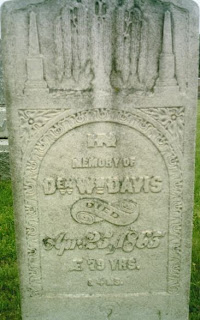
William Davis' Grave, Orwell Cemetery, Ontario. "In memory of Dea W. Davis, died Apr. 25, 1865 AE 79 Yrs. 4 MS."
It might be  helpful to list Deacon Davis' children before we begin. With his first wife, Temperance Leek, he had Richard (b. 1805), William Hempstead (b. 1806), Warren F. (b. 1807), Septimus (b. 1809) and Mahetible (date unknown).  With his second wife, Mary Sibley, he had Elizabeth (Betsy) Jane (b. 1818), Temperance (b. about 1819-1821), David F. (b. 1822), Joel Wallace (b. 1827), Adoniram (b. 1830), Ursula (b. abt. 1831), Euseba (b. abt. 1835), John (b. 1837) and Edwin R. (b. 1843). Two of these must have died in infancy or childhood since there are several references to the Davis family consisting of 12 children.  I'm guessing perhaps Temperance and Mahetible, since they don't appear on any further records.   I can't find death records or tombstones for them, though.

From the "Aylmer Express", 17 Sept. 1903 p1.c1.

"We are sorry to chronicle the death of Mr. A.J. Davis, which took place at his residence on Pine Street on Friday last, Sept. 11th.  Mr. Davis was in his 74th year, and for many of years (sic) was a resident of Aylmer and vicinity and one of our leading citizens.  He was held in the highest esteem by all who knew him, and many friends and relatives mourn his decease.  The funeral took place on Sunday from his late residence to the Baptist church, where a very impressive service was held. Interment took place in the Orwell cemetery." 

From the "Aylmer Express", 24 Sept. 1903 p. 12 c. 3.

"The following additional facts concerning the late A.J. Davis which we were unable to give in our last week's issue will be of interest to many of our readers.  He was born on the old Davis homestead in Orwell in 1829, his father, Deacon William Davis, being one of the first settlers in Malahide, coming here in 1810, from New York.  When 23 years of age he married Louisa A. Norton and the union proved a most happy as well as long one, she having been a model of kindness and faithfulness during both health and sickness up to the time of his death.  Mr. Davis was at one time Canadian representative of the Whitney Music Co., of Detroit, and also valuator for the Hamilton Trust & Loan Co., in both of which he was very successful.  He afterwards engaged largely in the real estate business and is said to have handled over a million dollars worth of property.  His beautiful home on the 8th concession was known all over the country, and his genial happy disposition made it one of the most pleasant in the country.  He was a faithful member and a liberal supporter of the Baptist church, and a liberal in politics.  Besides a wife he leaves one son, Dr. W.N. Davis, of Spokane, Wash., and one daughter, Mrs. A.H. Scott, of Montreal.  Two brothers and one sister of a family of 12 remain, viz., David F. of Orwell, Edwin R., of Delaware, and Mrs. U. Barber, of Chicago."

I had assumed that Adoniram was a farmer for some reason (some of his brothers are), but it appears he was a businessman. It's interesting to see how many of his siblings ended up back in the United States, and his son as well.

From the "Aylmer Express", 7 March 1907, p.1 c.5.

"The remains of the late Mrs. A.J. Davis were brought here on Friday last for interment, from Mount Holly, Vt., where she died very suddenly from heart failure the Wednesday previous.  She had had a severe attack about a week before but had about recovered when she was taken again and died before the physician could arrive.  The deceased had gone to visit her sister about a month ago, while her daughter Mrs. Scott was taking a trip through Europe with her husband and is now in Spain.  After her illness the week before Mrs. Davis made the request that in case of her death she should  be brought to Aylmer to the home of Mr. and Mrs. Davis G. Bingham.  This request was complied with, her nephew and niece, Mr. and Mrs. Horton accompanying the remains.  A short service was held at the house and public public services afterwards in the Baptist church, where deceased [sic] worshipped for many years as an honored member.  She was in her 82nd year and until recently has resided in this section for many years being one of our oldest and most esteemed citizens." 

Mrs. A.J. Davis was of course Louisa Norton, and I wonder if the niece and nephew who accompanied her body home were really Mr. and Mrs. Norton.  Of course, her sister could have married a man named Horton.  It sounds like Louisa may have moved into the home of Arthur and Minnie Davis in Montreal  in her later years.  The Binghams were probably relatives;  William Davis and Mary Sibley's oldest daughter Elizabeth Jane Davis married a William Bingham.

Adoniram and Louisa Davis, Orwell Cemetery. 

Also in Orwell cemetery are graves for two of Adoniram and Louisa's children who died young.  I'm not sure of their exact ages, but Adoniram and Louisa married in 1852, so Judson would have to be under 8 years old, and Wallace under 13.


Joel Davis, who was the next brother up from Adoniram (three years older) died in 1893.  Here's his obituary, from the "Aylmer Express", 16 March 1893, p.4A.

"AT REST:  After a long and tedious illness, borne with true Christian patience, one of the most esteemed, and useful citizens of this section, passed away to his reward at his home on the 9th con. on Monday last, in the person of Mr. Joel W. Davis.  Mr. Davis was a son of the late Deacon William Davis, one of the very earliest settlers in this section, who came here in 1809, and settled on what is known as the old Davis homestead at Orwell.  Here he raised a family of nine sons and three daughters.  He was one of the organizers of the first Baptist church in the county, viz. the old Malahide Baptist Church formed in 1816.  The late Joel W. Davis was born on the old homestead and lived there until the time of his marriage to Miss Catherine Adams, daughter of the late Wm. Adams, about 37 years ago, when he moved out on the 9th con., where he resided the balance of his life.  He was a consistent member of the Baptist church for a great many years, and was elected to the office of deacon, to succeed his father, on Jan. 9th, 1864, since which time he has been one of the leading as well as most consistant [sic] living members of that church.  

Besides his widow, he leaves two sons, Mahlon, civil engineer of Woodstock, and Edward E., who holds a responsible position on the railroad at Colorado Springs, Col., and an adopted daughter, Miss Dora McDonald, who is, and has been for years, a true daughter in everything but name.  The brothers and sisters who remain are David F., Adoniram J., and Edwin R, Mrs Bingham and Mrs. Barber, all of whom reside in town except David, who resides a few miles out. 

Mr. Davis was not an old man, not as old as many supposed, being only 65 last August.  His health has been poor for a number of years past, and a year ago last winter he spent in Colorado with his son, in the hopes that the change would do him good.  He was somewhat improved on his return, but soon after began to fail, and finally passed peacefully away on Monday last as stated above.

In politics he was a Reformer, but being of a rather reserved nature, took very little part in public life, farther than to represent his township on the council board for a year or so.  In his death the township of Malahide loses a good citizen;  the Aylmer Baptist church, one of its oldest and most faithful adherents and supporters;  and the family, a kind and loving father, husband, and brother.  We can all learn a lesson from his life and death, and profit by his noble example of christian living. The funeral took place yesterday afternoon from the house, to the Aylmer cemetery, and was one of the largest ever seen in this section."

Here is an obituary for Adoniram J.'s brother, David (Flint or Franklin) Davis, who died a few years after his brother Joel.  From the "Aylmer Express", 7 March 1912, p. 6A c.2.

"MALAHIDE'S GRAND OLD MAN:  Every country, and almost every section of country, has some one man, who, for age, sound judgment, high moral character and honorable dealings, stands out pre-eminently above his fellow man and is looked upon as a kind of father in Israel, its first gentleman and most honored citizen.  We do not know of any person in this section of country who filled that position and came up to that standard so well as Mr. David F. Davis, who passed to the great beyond at his home north of Orwell, on Sunday last, in his 90th year.  A man, full of years and honor, respected and loved by everyone, his death leaves a vacancy in this community which will not be filled for many years, if ever.  Mr. Davis was a son of Deacon Wm. Davis, who settled in this country in the year 1809 and raised a family of 12 children, all of whom have passed away except one daughter, Mrs. U.M. Barber, of Potter Valley, Cal.  Many of the best and leading families in this section at the present day, trace back to this good man with pardonable pride, and perhaps, the descendants of no other one man have done so much for the advancement of this section, both morally and physically as has those of Deacon Wm. Davis.  The subject of this sketch was a noble son of a worthy father, and for years the name of David Davis has stood for all that was honorable and just between man and man.  It is no idle word to say that his word was as good as his bond.  Time and again, questions in dispute have been left to him as sole arbitrator, instead of going to law, because his judgment was considered clear and good, and his integrity beyond question. In his younger days he took a deep interest in municipal matters, and several times was reeve, and member of the county council.  While at the county council, he became interested in the question of a county house, and perhaps to him is due, more than to any other person that it was built when it was.  Uncle David Davis loved clean sport, especially angling, at which he was an expert.  He was never happier than when he was helping someone, and his flowing well, which he turned out on to the road for the use of man and beast, was a great source of pleasure to him.  He was born on the farm where he lived all his life, and where he died.  In politics he was a Reformer and one of the oldest subscribers to the Globe in Canada.  He has also been a regular subscriber to the Express ever since it was started, and seldom came to town without calling, for what to us was always a most enjoyable visit.  He was a member of the Baptist church, and his religion was to do the most good to his fellow man.  He leaves two daughters, Mrs. Albert White and Mrs. (Dr.} McLay and one sister, Mrs. Barber.  Funeral services were conducted at the house on Tuesday afternoon by the Rev. G.R. Welch.  Interment in Orwell cemetery."  


Orwell Cemetery, David F. Davis and his wife Mary.

From Aylmer Cemetery, here is the grave of William Hempstead Davis, 2nd son of Deacon William Davis and his first wife Temperance Leek.  He was born in New York in January of 1806 and moved to Ontario when he was three or four.
Aylmer Cemetery.  Wm. H. Davis DIED Nov 23, 1880, Aged 74 Yrs & 10 M's.

And here is his younger brother Warren F. Davis, born in New York in 1807 and buried in Orwell Cemetery. He died in 1885, but his gravestone  looks quite modern.

In Memory Of Warren F. Davis, Died March 25, 1885 Aged 78 years And His Wife Anna E. Wilcox...
Septimus Davis, the fourth son of Deacon William and Temperance Leek, is buried in the St. Thomas cemetery.  He was also born in New York, in 1809, and would have been an infant upon his arrival in Ontario.  Note the spelling of his name on the gravestone.

In Memory of Septymius Davis, Died May 1, 1883, Aged 74 years & ? Mos. Our Father. 

The grave stone for John Davis is in exactly the same pattern as his father Deacon William Davis.  It's quite intricately detailed.  It's located in Orwell cemetery.  John died at quite a young age but he was married, to Cornelia Jackson.  They had been married for two years when he died.

In Memory of John S. Davis, Died Feb. 5, 1860, AE 23 Yrs. (&5 Ms.?)

Finally, the youngest child, Edwin R. Davis.  He is buried in Orwell cemetery.  


I haven't had lots of luck finding gravesites for the daughters of the family.  I'll keep looking. 

Monday, December 3, 2012

Defying the Frost King: Pioneer Life in Fact and Fiction

Pa Ingalls, frontier pioneer,  as illustrated by Garth Williams
for the Little House series.
I recently read a book that apparently has been astonishingly popular with a certain breed of woman.  No, not that book--I'm talking about Wendy McClure's The Wilder Life:  My Adventures in the Lost World of Little House on the Prairie.  It really took me back--I remember reading every one of the Little House books, some more than once (and also watching some of the television series later on) and while I don't really remember too many plot points, I am left with certain images--cozy log cabins with crackling fires, skating on frozen lakes, Pa playing his fiddle while the girls drift off to sleep in their nest-like loft. I do remember that Pa got lost in a blizzard right before Christmas at one point and ate the two oranges which were supposed to be Laura and Mary's Christmas treats.  After that I developed a thing for getting an orange in my Christmas stocking.  Wendy McClure found--and still finds, as an adult--these elegaic books so compelling that for some time she made a project of living, as she puts it, La Vida Laura--in other words, trying to recreate some of Laura's pioneer experiences, like churning her own butter, or baking bread with wheat she had ground by hand.  Chores as entertainment! She also makes a kind of pilgrimage with her very patient fiance, visiting all sorts of Laura-associated sites and events, like Laurapalooza (really, I'm not kidding), and a museum which has a photographic portrait of the real Charles Ingalls which left one visitor visibly shaken and squawking with disbelief (she was expecting someone more Michael Landon-esque).  At one point, McClure visits one of the Ingall's homes, an earthen dugout that was "smaller than a freight elevator", and muses that "the actual past and the Little House world had different properties."


Pa  "Beefcake" Ingalls on TV,  played  by Michael Landon 
Pa playing his iconic fiddle in the stage version of
"Little House on the Prairie".  The day's chores are
done, it's time to dance!

The real Ma and Pa Ingalls--Charles Ingalls and Caroline (Quiner) Ingalls.
Get a load of that beard!  Or is it a moustache?


After I read The Wilder Life, I went on to read Memoirs of a Prairie Bitch by Alison Arngrim. She played the villain Nellie Oleson in the TV show, and she has many hilarious stories to tell about people confusing the show with reality--for example, once she and the actress who played her mother visited a school to promote the series and were actually attacked by the schoolkids.  Also, she and Melissa Gilbert, who played Laura, became friends and when they were out together people would try to warn Melissa that Nellie Oleson was nearby.  This is when they were wearing regular clothing, not pioneer garb. And some of these people were grown adults!

Mean old Nellie Oleson has her say. 
Books like Little House that romanticize the frontier/pioneer experience have had a tremendous influence on how we think of "pioneer life".  Just for fun, I thought I'd look into the Ontario pioneer lifestyle which the Davis family would have lived.  It's described in a book called Historical Sketches of the County of Elgin, published by "The Elgin Historical and Scientific Institute" in St. Thomas, Ontario, in 1895.  It quotes an anonymous old-timer on the subject of pioneer life in Elgin County.  The William Davis family arrived from New York around 1809-1810, during the time this passage discusses.  I'm quoting here from pages 12-15.

"The first improvement of this settlement...was in 1810. In 1812 the Americans declared war against Great Britain, and Canada was the theatre of their operations:  so that improvement in the settlement was suspended for three years, which was a trying time for empty purses and lonely women, while the husbands were on duty to protect a home that was yet in embryo...The first act of a settler was with axe in hand to select a spot on which to erect a shanty;  then felling the huge trees...then the timber had to be cut piled and burned to form a starting point for further improvement.  The shanties were uniformly built of logs with elm bark for roof and floor. Then came the furniture which was invariably of home manufacture.  The bedstead was made of poles with bark taken off and basswood bark for bedcord, and the tools for its construction were an axe and an auger.  The table leaf was made from a piece of wood two inches thick, split from the centre of a large log, and holes made from a two inch auger to receive the legs;  the seats were tripods, the material and workmanship the same as the table.  Then cradles were ready for use by putting rockers to a sap-trough.  I knew one family where the same sap-trough served to rock four of their babies in succession."  

An illustration of a log shanty with bark roof. Notice there
are no windows.  A typical shanty would have only one room. 

Photograph of a log shanty with bark roof.  Notice the size
in relation to the family.  Notice also the catch hanging from the roof.
Typically mud would be used for caulking.   It doesn't seem to have a chimney...
I can't see it keeping out either cold or mosquitoes. 
"The mortar was indispensable in each family.  This article was made by cutting a log three feet long and 15 inches in diameter.  The log then stood on end and a fire kept burning in the centre till it formed a bowl-shaped concavity to hold ten or twelve quarts.  Into this a quart of corn was put and with a heavy wooden pestle pounded to the required degree of fineness, which process had to be repeated morning noon and night--or go without the indispensable johnny cake."

A "johnny cake" was a cornmeal flatbread.  Apparently the Little House Cookbook includes a recipe for this pioneer staple!


But back to our historical sketches.  The effect of the War of 1812 on shopping and provisions is described:

"'During the war', we are told, nearly all the settlers had to go to Port Ryerse for their salt, pay $12.00 a bushel for it and carry it home on their backs.  In the winter of 1813 I went to long point and paid $6.00 for 28 pounds, a neighbour offering to take it home in his sleigh.  He staid over night on the road, but left his load exposed, so that a cow destroyed the salt, killed herself, and caused me to return to replace the loss.  This necessitated 200 miles of travel on foot, and $12.00 in cash, to realize 28 pounds of salt.  During an unusual scarcity a pedlar came with a horse load.  I took 14 pounds for which I paid $8.00.  Two of my neighbours...went to Hamilton and paid $75.00 for a barrel, and allowing for their time, expense and team, it cost them $100.00.  But a few days after peace was proclaimed, and in a short time salt could be had at Port Ryerse for $12.00 a barrel."

Port Ryerse, in case you don't know,  is on Lake Erie, in Norfolk county, just west of Port Dover.  It's 36 miles west of Aylmer, 46 miles west of St. Thomas, "as the crow flies".  That's a painfully long walk with a bushel of salt on your back.

Perpetuating what I suspect is the Myth of the Happy Pioneer, Historical Sketches of Elgin County  assures us that early settlers, despite their lack of creature comforts,  had sunshiny temperaments: .

"The hardships, the privations, the discomforts of those earliest and even later days were very great and real,  though borne with great cheerfulness.  Bad roads, or none at all, scarcity of everything, except fuel and perhaps game, poor clothing, rude huts, rather than houses, the wolf literally at the door, or howling near it, every night--such seem to have been the common lot of all the first settlers... sheep were unknown in the Talbot settlement for the first ten or twenty years [perhaps because of the wolves],  flax forming the staple material for clothing.  The climate was quite as rigorous...then as now,--yet the hardy settlers battled with the forest and defied the frost king, despite the lack of woollen garments and other things accounted luxuries then--necessaries now." 

With all that hunting, though, wouldn't they have made themselves winter clothes out of animal fur?

To me, all this seems like a tremendously challenging undertaking, one that, if you lived through once, you wouldn't want to try again.  But with more of a sense of adventure than I have, one of William Davis's sons,  Edwin E. Davis (who was, obviously, also Adoniram Davis's brother and Minnie (Davis) Scott's uncle), moved to the Dakota frontier in the 1800s in search of land.  The Ingalls family lived in Dakota for a few years in the 1860s--we missed them by a measly two decades!

Friday, November 30, 2012

A Dollar and an Ax: The Davis Family, Pioneers in Elgin County

House of Andrus Davis, brother of William Davis and Pioneer in Orwell, Ontario. 


It hasn't been easy finding information about the Davis family of Elgin County.  I have very few vital records for them, Davis is a common name, and from census records it's hard to tell who is related and in what way.  In a previous post I talked about how I tried to connect the dots on this group of people using secondary records and family names.  Sims History of Elgin County, Volume II by Hugh Joffree Sims (published by The Aylmer Express Limited, 1986) fortunately gives us some information about this elusive family.

Here's what Sims has to say about William Davis, one of the pioneers of Elgin County:

Orwell (Temperanceville--Catfish Corners):

"Catfish Corners [an early name for Orwell] was just a stake in the earth when Deacon William Davis and his wife settled there after a lengthy journey from his home on Schohario, New York, in 1809.  In this locality he obtained a large tract of land from the Crown and established the first gristmillIt was a stump mill made out of a hollowed out buttonwood stump. This type of mill was in use by many early settlers throughout Elgin County;  it was replaced by the hand-mill or quern, which was made of field stones. The daily output of a stump mill was twenty bushels.  William Davis was followed by his brothers Andrus, Daniel, Simeon, and Joel, and his sisters Hannah, Polly and the one that became Mrs. Brown in 1811.  Deacon Davis lived on his farm until his death in 1865 at the age of seventy-nine.  During his lifetime he helped clear a road through the woods to the site of St. Thomas and on eastward to Aylmer.  He became a deacon in his church and organized the first Baptist church in the township and built the first school near Orwell.  When Davis first arrived here in 1809, all he had to his name was $1.00 and an axe.  At his death he left behind nine hundred acres of cleared land in Yarmouth and Malahide Townships.  He served in the War of 1812.  David F. Davis, his son, was born in Orwell in 1822.  He married Mary Birdsall, and became a magistrate.  He lived on the homestead until he moved to Aylmer.  

Deacon Davis married twice.  His first wife was Miss Leek [Temperance Leek--they married in the United States] and by this marriage he had five children:  Richard, Hempstead, Warren, Septimus, and Mathatible (sic).  By his second marriage to Mary Sibley he had eight children:  Betsy Jane, Temperance, David F., Joel M., Adoniram J., Ursula, John, and Edwin E.  Edwin moved to Dakota in 1881 and became part of the history of the Old West.  The son of Warren Davis, William Andrew, sought his livelihood in Dakota where he died in 1908 at fifty-eight.  His brother, George P. Davis, ended his days as a farmer in Watertown, Dakota....Joel Davis settled on four hundred acres east of Sparta around the year 1837.  Joel Davis farmed for a short time, but hearing of the great tracts of land that were available in Illinois, he left and got 1,000 acres there.  He then returned to Sparta to complete the closing of his estate.  He fell ill at Fingal and died suddenly at twenty-seven years of age.  His body was conveyed to Aylmer and buried.  One of Joel Davis's sisters married John Brown who, along with William Andrew Davis, had the first saw and gristmill on Catfish Creek at Orwell in 1817...The old Andrus Davis house was a large frame house with four fireplaces and a huge hall on the upper floor which served as a ballroom on many occasions.  The old Simeon Davis hotel that was located east of Roger's Corners was of similar architecture. The old house was built in 1830..."


A stump mill was a hollowed-out stump with an oversized pestle to grind grain
by hand.  It was hard work.  I can't believe William got 20 bushels a day from this!

Quern or hand mill to grind wheat and other grains.

This is great stuff--now I know which people were William's siblings and which ones were his children.  I also know where he came from, and that he fought in the War of 1812.  I find that interesting, considering that he had just immigrated from the United States a few years earlier.  Doug and I both feel that the comment about the dollar and the ax is probably rhetorical--he brought his wife and some children along with him, so I'm imagining they had clothes, blankets, kitchen ware, and perhaps a horse and wagon or cart.  However, the point that he arrived with very little and built a great deal is well taken.